1.1 System background, purpose and features
A student leaving an empty classroom can turn off a lamp, but how much electricity would that save over a week? My website gives students a way to answer that question and explore four related topics: preventing pollution, planting and caring for trees, sorting waste, and understanding climate change. A student can run the estimator directly on a phone or open the downloaded site on a school computer.
Software engineering separates the interface, styling, and calculation. Human-computer interaction shapes the field labels and feedback. Networking supports optional web delivery. Database design and analytics enter my proposal for maintaining guides and evaluating learning. The submitted version processes numbers on the device.
1.2 Audience, user goals and core tasks
| User and context | Route and success condition | Complexity |
|---|---|---|
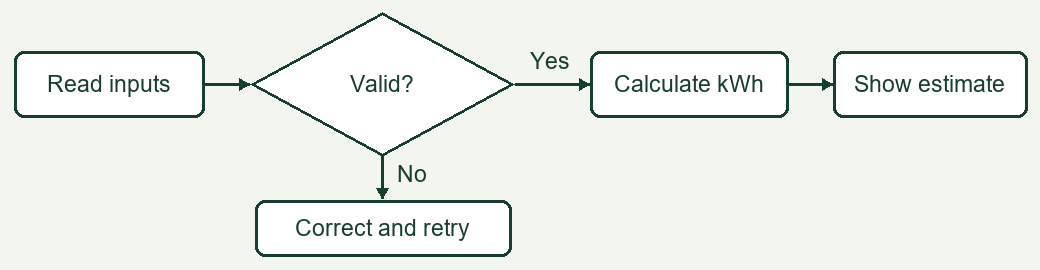
| Student with basic browsing skills | Open the estimator, read a lamp’s wattage, enter hours avoided, then calculate a weekly estimate in kWh. | Moderate. A label rating and two units must be interpreted. |
| Student packing lunch | Open Prevent pollution. Choose one disposable item to replace on the next school day. | Low. One guide leads to a concrete choice. |
| Family member sorting a bottle | Open Sort waste. Identify the material and check the school or collector’s accepted-items list. | Moderate. The final decision depends on local rules. |
| School club volunteer | Open Care for a tree. Identify a suitable follow-up action and who will check the seedling. | Low for finding a step. Site-specific care needs guidance. |
1.3 SDG 13 – Climate Action
I chose SDG 13 because climate change affects our environment and people's lives. My website aims to encourage people to protect nature by sharing simple tips such as saving electricity, planting trees, reducing plastic use, and keeping the surroundings clean. UN target 13.3 calls for climate education and awareness [1]. The calculator links a familiar action to a quantity a student can check. Switching off a 10 W lamp for two otherwise unused hours each day avoids an estimated 0.14 kWh over seven days. In a system supplied partly by fossil fuels, lower electricity demand can reduce associated emissions. The local generation mix and timing influence that relationship.
The guides extend that lesson beyond electricity. Reusing a bottle can reduce demand for new material, while caring for an existing seedling supports its growth. A student can explain one choice and its likely effect. Measuring an actual reduction would require tracking behavior and energy use.